“It’s early days for online education,” declared a recent article in the
technology blogTechcrunch
[http://techcrunch.com/2013/03/22/72-of-professors-who-teach-online-courses-dont-think-their-students-deserve-
Here’s a little secret: when I started teaching people how to teach online, I
had no clue what I was doing.
It was 1998. I was a graduate student, without extensive computer
It’s evening. An Irish pub in Louisville, Colorado. Fish and chips. Beer. A game
of soccer on the TV. I’m sitting down with one of my faculty to revisit the
department’
This is the first ofa four-part colloquy of articles
[http://www.hybridpedagogy.com/tag/online-learning-colloquy]. Each piece has
been contributed by authors who have intimate experience with the struggles,
failures,
On December 14, 2012, a group of 12 assembled in Palo Alto for a raucous
discussion of online education.Hybrid PedagogycontributorsSean Michael Morrisand
Jesse Stommelgathered together with folks from a diverse array of
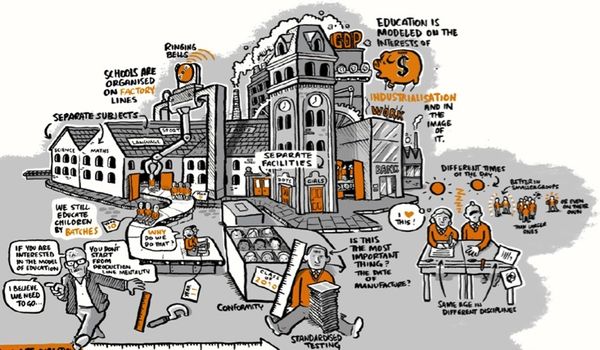
At exactly this moment, online education is poised (and threatening) to
replicate the conditions, courses, structures, and hierarchical relations of
brick-and-mortar industrial-era education. Cathy N. Davidson argued exactly this
at
Online learning is not the whipping boy of higher education. As a classroom
teacher first and foremost, I have no interest in proselytizing for online
learning, but to roundly condemn it is absurd.
This sentence is a learning object. Wayne Hodgins, the “father of learning
objects,” first came up with the idea for them while watching his son play with
LEGOs. The basic notion is that
This is the third in aseries of articles
[http://www.hybridpedagogy.com/tag/curriculum-crowdsourcing]that works to get
feedback on the program I’m directing and helping to develop at Marylhurst
University
This is the second in aseries of articles
[http://www.hybridpedagogy.com/tag/curriculum-crowdsourcing]that works to get
feedback on the program I’m directing and helping to develop at Marylhurst
University
This is the first in aseries of articles
[http://www.hybridpedagogy.com/tag/curriculum-crowdsourcing]. Clickhere
[http://www.hybridpedagogy.com/Journal/files/crowdsourcing_a_curriculum_2.html]
for part two on design principles.
Early web commenters referred to the Internet as a primitive, lawless place like
the “Wild West.” Plenty still needs to change to make certain parts of the web
more civil and useful, but
All participation is not equal. Digital media prompt us for comments, but in an
academic setting we should harness this cultural habit to teach the difference
between expressing opinion and authentic engagement. Professors